Projects /
Wood and Innovation:
the Transformative Force
of the PRISMA Project
In several mountain valleys of the Pyrenees, Central Catalonia and Biscay, entire forests grow with species that, despite their ecological and technological value, still lack clear market pathways. These are landscapes rich in forest resources but with little or no active management, accumulating fuel, losing biodiversity and leaving many opportunities unexplored.
The PRISMA project was born from this reality, with the aim of transforming it through the territory’s own resources, which offer high added‑value potential.
The project strategy goes far beyond the conventional uses of wood, such as packaging or bioenergy. It opens new pathways with greater added value: construction, carpentry, joinery, and the design industry, among others.
This makes the use of local material a central pillar of PRISMA. All the material used comes from the three territories where the project is developed, and specifically from the forests where planning and management actions take place. The project partners themselves supply the sawn timber and wood chips for testing
Investing in 21st-Century Forests:
empowered, innovative, and entrepreneurial
Developing Short Forest Value Chains
Promoting a Sustainable Circular Bioeconomy
Strengthening Climate‑Adapted Multifunctional Forest Management
Valuing Local Bioproducts and Ecosystem Services
Communicating, Raising Awareness, Transferring Knowledge and Generating Impact
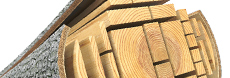
One of the project’s main goals is to valorise currently underused mountain forest species by developing new technological products. Research activities include the characterisation and pre‑industrial production of cross‑laminated timber (CLT) using combinations of conifer and hardwood species.
PRISMA also runs tests to explore new construction solutions, such as light‑frame systems made with conifers from the Pyrenees (e.g., FustaBlock). In parallel, the project works on valorising forest by‑products for new market niches linked to green chemistry.
A territory‑rooted
value chain
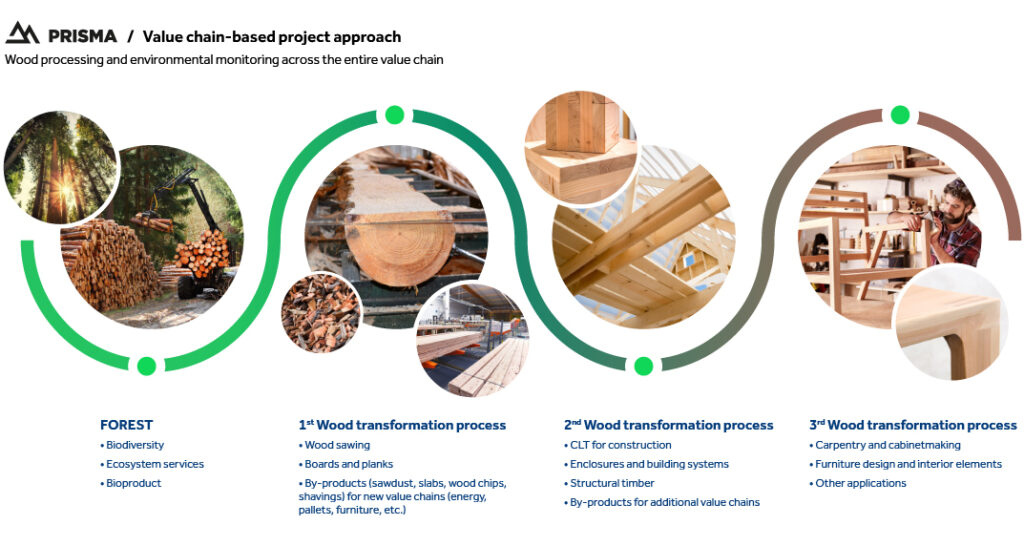
PRISMA addresses the entire chain: from the forest to the final consumer.
It assesses the environmental impacts of the defined R&D&I actions in several pilot areas. This includes validating digital tools for multi‑objective forest planning and management, and optimising available resources and ecosystem services.
From an economic and social perspective, the project promotes activities that create jobs and revitalise the territory.
In the first transformation, sawn timber, boards and planks are produced, along with by‑products such as sawdust, slabs, chips or fuelwood that feed new value chains (energy, pallets, furniture).
In the second transformation, engineered wood products such as CLT is produced for structural uses, enclosures and construction applications, while by‑products are reused for other purposes.
The third transformation includes carpentry, joinery, furniture design and interior applications with high added value.
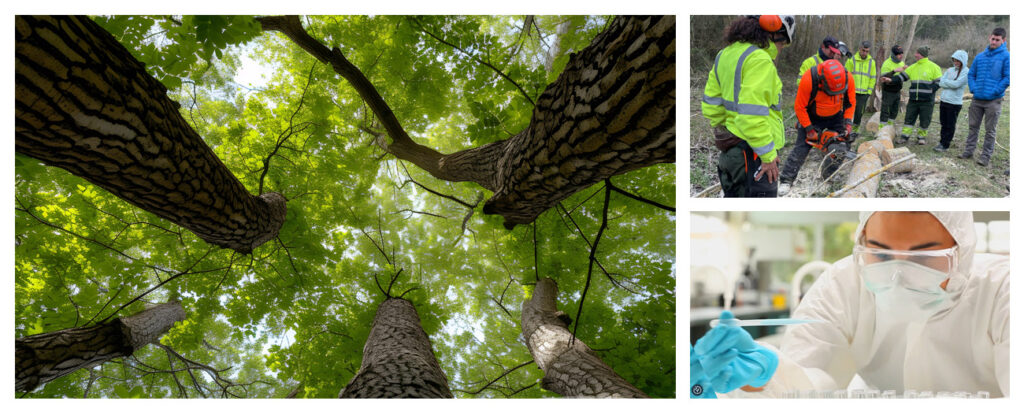
This approach creates new job opportunities, revitalises traditional skills and supports generational renewal. Training and capacity‑building activities are also provided for forestry and wood professionals, from a multidimensional and collaborative perspective.
Environmental, energy-efficiency, and sustainable management criteria guide both the design and execution phases. Pilot actions aim to improve biodiversity, forest stand quality, climate change mitigation and wildfire prevention.
A common methodology is defined to reduce negative environmental impacts from forest operations, and machinery and components are adapted to better meet sustainability objectives. Other work lines include comparative studies of self‑consumption facilities and the identification of high‑value bioproducts and ecosystem services.
Environmental and social impact
On a territorial scale, the project contributes to reducing wildfire risk through biomass use, improving habitats of threatened species, repopulating declining rural areas in the Pyrenees and in mixed Atlantic forests, restoring mosaic landscapes and riparian habitats in Biscay. All of this translates into measurable improvements in ecosystem services such as water regulation and carbon sequestration capacity.
Throughout its development, PRISMA has faced several challenges. One of the most significant has been defining commercial exploitation pathways and intellectual property routes, and identifying market trends that can connect emerging bioproducts with real demand.
In the Mediterranean context, PRISMA represents a transformative initiative that starts from a low‑managed forest reality but with high‑value resources. The project operates from scientific knowledge and applied research to generate a territory‑rooted model, capable of providing innovative and sustainable responses to today’s environmental, economic and social challenges.