Skip to content

Areas /

Wood

Truffle

Aromatic and medicinal plants

Green chemistry

Pine nuts

Environmental planning and management

Innovation in forestry work

Services /

Product development

Advisory services

Training

Certification

Large‑scale project

Projects /

A building that paves the way: the case of the Forestry Hub

Bioproducts from Mediterranean forest biomass

Association of Truffle Producers of Catalonia

SAMBUCUS Cooperative

Wood and Innovation: the Transformative Force of the PRISMA Project

Soriguera: from agroforestry mosaic to resilient landscape

Recovery of Forests with MALWA Machinery

Recovery of Forests
with MALWA Machinery

The excellent properties of Mediterranean wood species —such as Aleppo pine (Pinus halepensis), black pine (Pinus nigra) or Scots pine (Pinus sylvestris)— are often underestimated, as is the potential of the dense young stands that dominate many landscapes. Many of these forests frequently remain unmanaged because operations are not economically profitable: costs are high and returns are slow. To address this challenge, MALWA machinery has been introduced. It is lighter, smaller and more agile than conventional forestry equipment, enabling work on slopes and in shrubdominated areas. These characteristics make it possible to intervene in forest sectors that were previously difficult or nearly impossible to manage.  

Young stands can evolve into productive and sustainable adult forests if the right silviculture and adapted mechanisation are applied. This is where the MALWA machine comes in: a compact harvester capable of working in dense forests and fragile soils, reducing costs and maximising wood harvesting. 

Targeted interventions

Young stands often grow under challenging conditions: high tree density, competition for light and water, and poorly developed soils. Through targeted interventions, forest managers and silviculturists aim to achieve: 

Certificacio_UnCompromis_icon
Young forests that evolve towards healthier, more productive structures
Certificacio_UnCompromis_icon
Heterogeneous structures that modulate light and competition
Certificacio_UnCompromis_icon
Selective and frequent thinnings that benefits the best future trees without compromising stand stability.
Certificacio_UnCompromis_icon
Maintenance of a closed canopy to control undergrowth and reduce wildfire risk
These interventions allow forests to evolve towards more complex, mature and productive structures, ready for the bioeconomy and capable of providing multiple ecosystem services: biodiversity, carbon sequestration, soil protection and landscape quality
Footer_logo_HUB

Silviculture adapted to
wildfire prevention and
biodiversity enhancement

The revolution of
compact mechanization

Silvicultural work in young forests has always been difficult. Large harvesters, designed for big‑diameter trees, are inefficient in dense, small‑diameter stands: they move poorly, damage the soil and cannot access many areas.

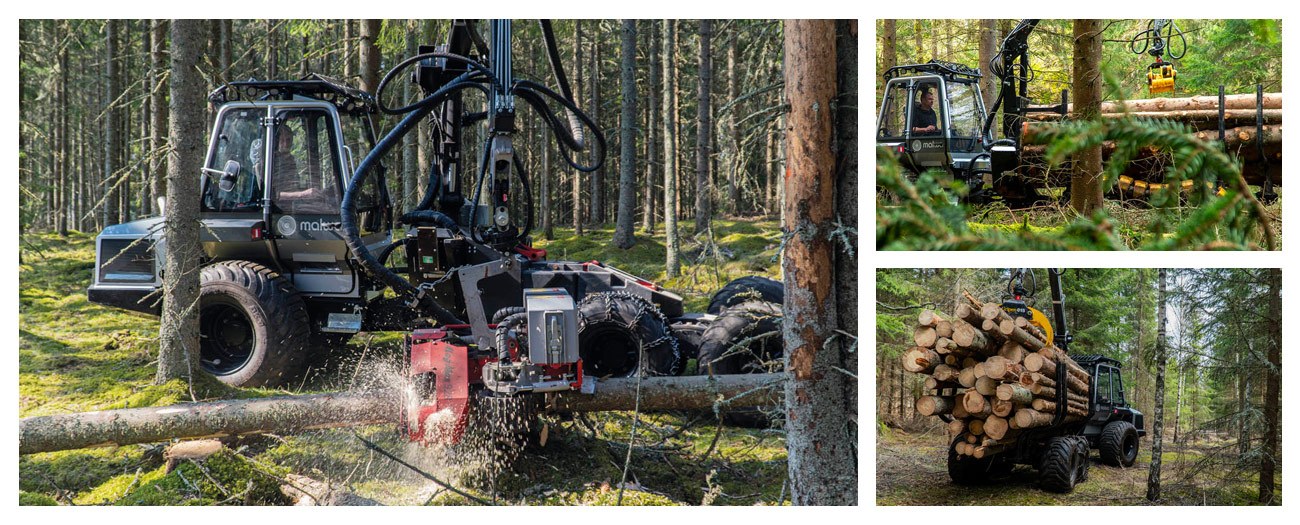
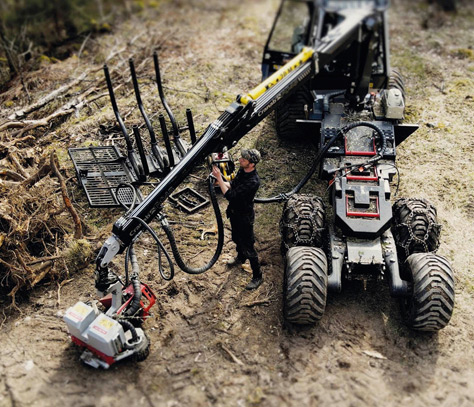
This is where the MALWA 560C Combi compact machine offers an innovative solution. Designed for small‑ and medium‑diameter forests, it provides versatility and efficiency:

Certificacio_UnCompromis_icon
Reduced width (1.95 m): access narrow trails and minimise soil impact
Certificacio_UnCompromis_icon
Low weight (5.7 t): reduces soil compaction and protects future vegetation.
Certificacio_UnCompromis_icon
Dual function: harvester and forwarder in one, cutting, processing and loading trees with a single machine.
Certificacio_UnCompromis_icon

LogMax 928 head: handles small and medium diameters with precision, improving final product quality.

Main advantages

PRO_Malwa_LaRevolucio_icon_1

Cost reduction:

demonstrations show that costs in young stands can be cut by more than half compared to manual work.

PRO_Malwa_LaRevolucio_icon_2

Lower environmental impact:

size and precision protect soil and future stands.

PRO_Malwa_LaRevolucio_icon_3

Productivity gains:

especially in pre‑commercial thinning and wildfire‑prevention work.

PRO_Malwa_LaRevolucio_icon_4

Flexibility:

easy transport and operation in steep or irregular terrain.

Practical demonstrations

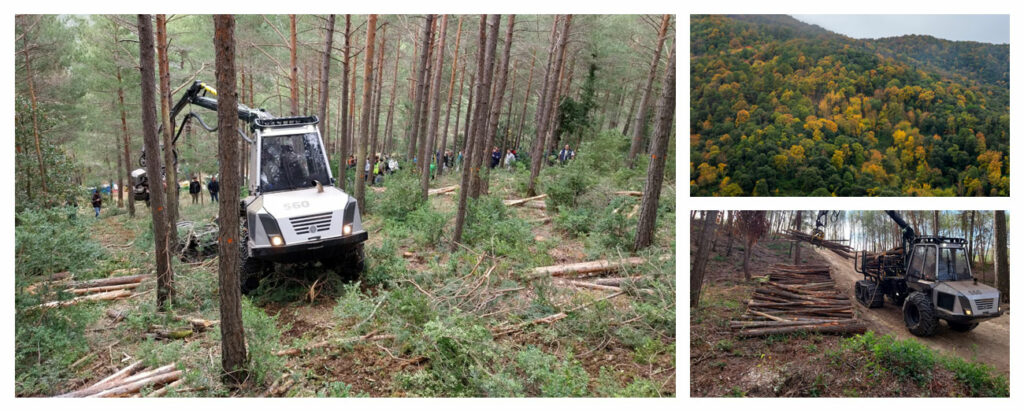
Demonstrations with compact MALWA machinery have shown how young, hard‑to‑manage forests can become safer, more productive and more useful for the bioeconomy. Two practical trials were carried out in Odèn and Viladecavalls:

Odèn (Scots pine)

Block 1: Larger diameter and lower density. Productivity was 2.3 m³ per hour, with a cost per cubic meter of €38, which indicates that it generates economic benefits.

Block 2: Smaller, denser trees, productivity was low (1.79 m³/h), and the unit cost increased (€50/m³).

Even with lower productivity, mechanisation reduced the need for subsidies to one third of what would be required for manual labour, making management viable in difficult areas.

Viladecavalls (post‑fire regenerated Aleppo pine)

Block 1: Stand with medium diameter trees and moderate density. Mechanization reduced the cost per hectare from €4,000 to €1,735, with a productivity of 2.6 m³/h and utilization of harvested wood. The treatment was viable without subsidies.

Block 2: Stand with smaller and denser trees. Productivity was low (1.6 m³/h) and unit cost was high (54 €/m³). Still, mechanised work reduced costs by around 50% compared to manual work.

Block 3: Very dense stand, small diameters. Use of boom corridors allowed efficient work in difficult conditions, improving productivity and intervention quality without harming selected trees.

The value of
demonstrations

• Young forests can be safely and efficiently managed, even in hard‑to‑access areas.

• Soil impact and damage to future stand structure are minimised.

• Forest resilience to fire and drought improves

• Harvested wood can be used, enabling economically viable management and contributing to the local bioeconomy

A future for
young forests

Demonstrations using compact MALWA machinery show that it is possible to intervene in forests that are currently not economically viable for management. This capability accelerates the transition towards healthier, more productive stands, with positive economic and environmental effects.

This process helps advance forest maturity, encouraging the presence of larger and older trees that are structurally more diverse and ecologically more stable, and therefore better able to provide a wider range of high-quality ecosystem services to the territory. Treated forests become:

Certificacio_UnCompromis_icon
More accessible, facilitating management and wildfire prevention
Certificacio_UnCompromis_icon

More resilient, better withstanding drought, pests and fire

Certificacio_UnCompromis_icon
Ecosystem‑service providers, offering biodiversity, carbon capture, soil protection and landscape value

Recovering and efficiently managing young forests requires combining three key factors:

Certificacio_UnCompromis_icon
Genetic improvement: reversing negative historical selection to obtain straighter, stronger and more adaptable trees.
Certificacio_UnCompromis_icon
Appropriate silvicultural treatments: selective thinning, light modulation and heterogeneous, resilient structures.
Certificacio_UnCompromis_icon
Compact MALWA mechanisation: light, versatile machines that reduce costs, minimise soil impact and maximise wood use in young, difficult stands.

This combination of genetic improvement, silviculture, and mechanisation ensures more productive Aleppo pine forests that are resilient to climate change, useful for the bioeconomy, and capable of delivering multiple ecosystem services over the long term.

Recover, manage and innovate:
three steps toward a resilient forest future

Footer_logo_HUB